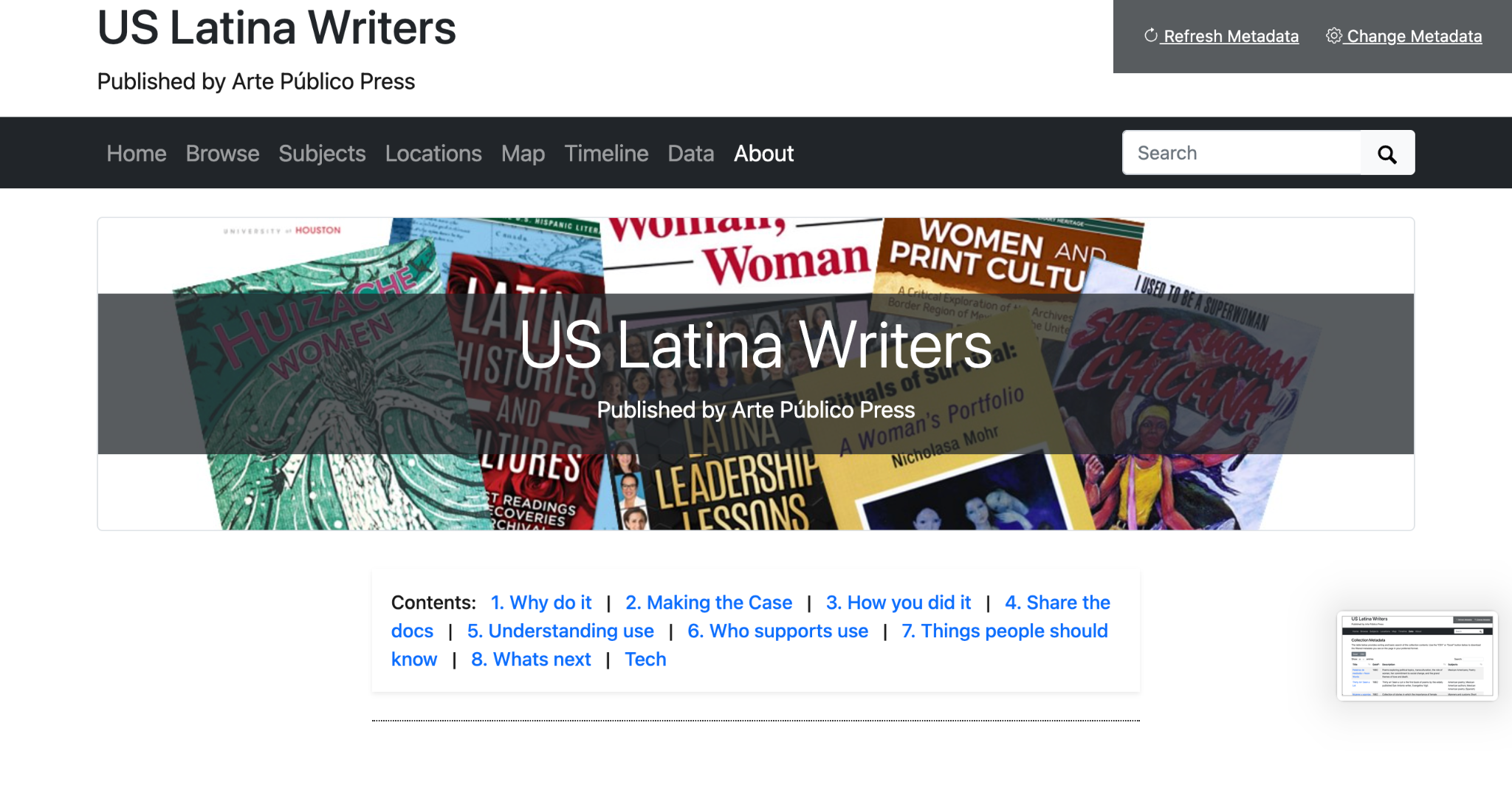
Digital Media Review of US Latina Writers
US Latina Writers was developed by Monika Dabrowska, Gabriela Baeza Ventura, and Carolina Villaroel, and published by Arte Público Press. It’s a website that serves as a database or digital library of about one hundred sixty-one literary works written by many different female Latina authors. It includes different tabs and links for an interactive map, a timeline of the works, audio files, images, video files, different ways to search (including a simple search bar), and basic information about the literary works as well as about the site itself. The platform was built using CollectionBuilder, which is an open-source framework for creating digital collections that are driven by metadata. Overall, the user experience for this website is good, although there are a few small issues of accessibility and downloadability.
The goal of US Latina Writers, which is written in the “About” tab on the front page and on the homepage (screenshot attached), is to preserve cultural heritage and encourage the reading, listening, and studying of these literary works. The website also aims to serve as a valuable resource to a broad audience of scholars, educators, librarians, and anyone who wants to know more about Latina authors and their literary works.
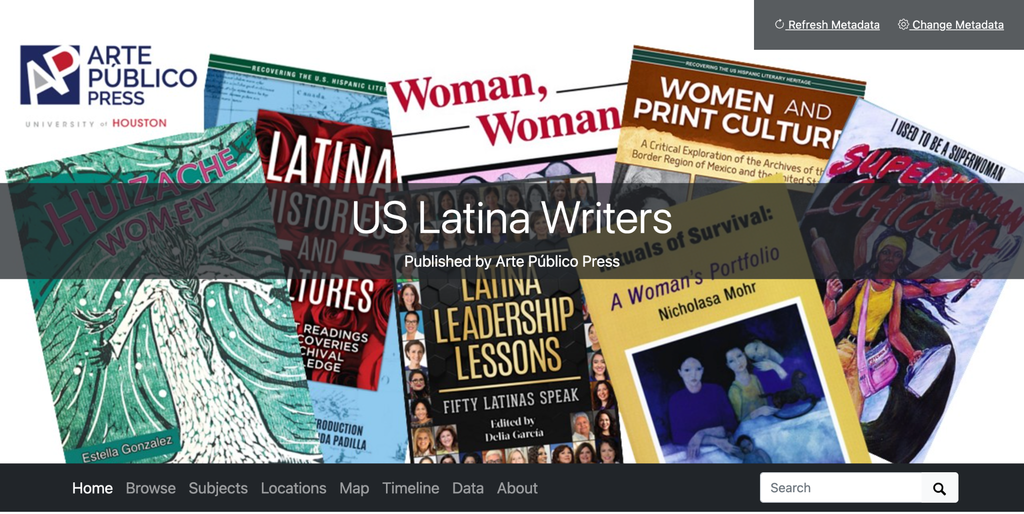
Homepage of US Latina Writers (shown above).
There are eight main tabs found on the homepage (see the screenshot above) of US Latina Writers: ‘Home’, ‘Browse’, ‘Subjects’, ‘Locations’, ‘Map’, ‘Timeline’, ‘Data’, and ‘About’. These eight tabs are very easy to find, and the search bar is available no matter what tab you click on.
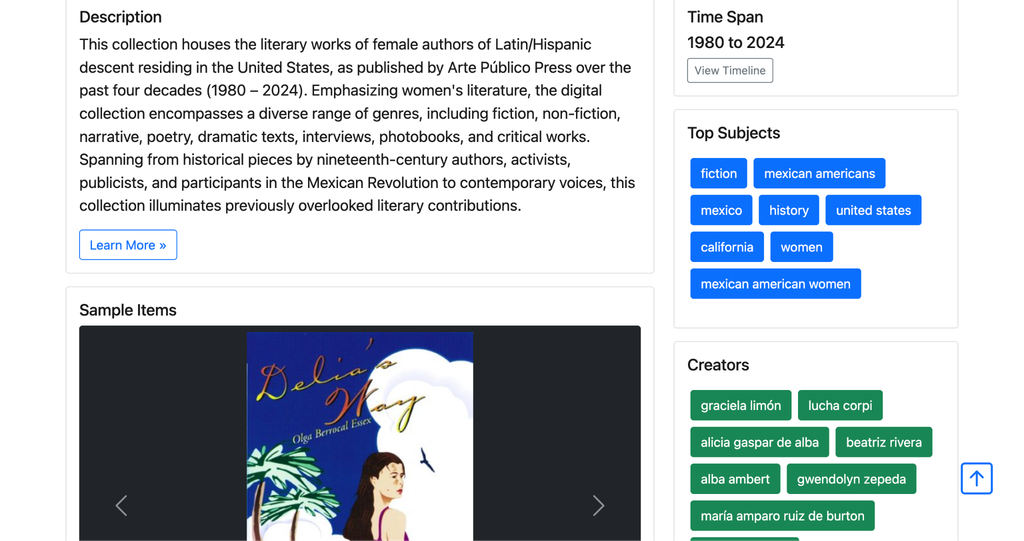
Description of the US Latina Writers website on the homepage (shown above).
The ‘Home’ tab is another way to get back to the homepage when navigating through the website. This can also be done by clicking on the logo in the top left corner titled US Latina Writers. The ‘Browse’ tab provides a simple search bar. Users can choose whether to sort the results by title, date, or just the search. This search includes all images, audio, video, and records of literary works in the collection. The ‘Subjects’ tab, along with the ‘Locations’ tab, is very similar to the ‘Browse’ tab, but rather than letting the user input a word into the search bar, it has a word cloud of key search terms for the user to click on. This can be helpful if the user wants ideas of some themes and key words regarding the subject and content of the work. The ‘Location’ tab, like the ‘Subject’ tab, has a word cloud of search terms. These search terms, however, all focus on where the work was written, which is helpful if the user wants a work written or set in a particular place.
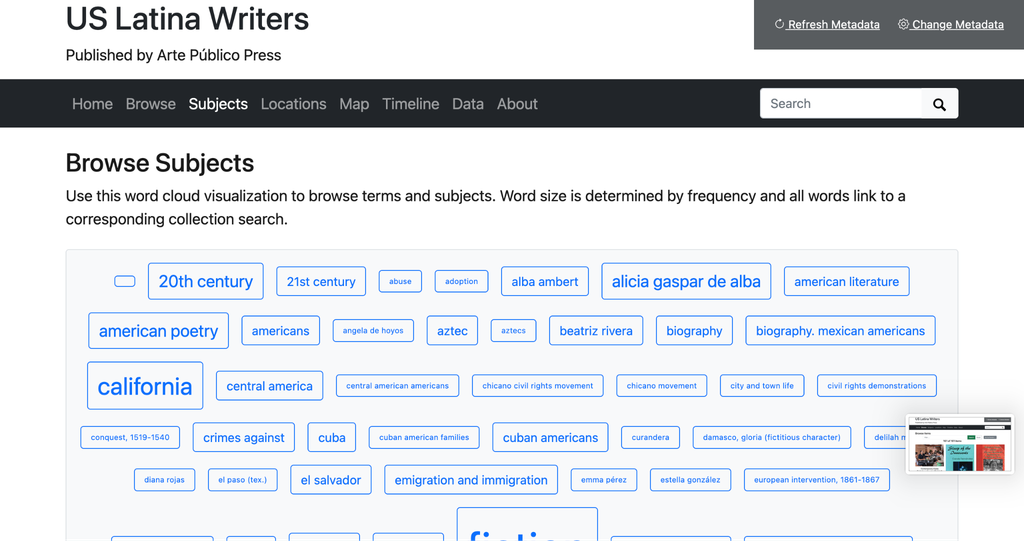
The ‘Browse’ tab screen and word cloud (shown above).
The ‘Map’ tab shows an interactive map of where each literary work was written. Many places have multiple dots, showing how many works were written there. Clicking on the dots shows each individual work. This is helpful in the sense that it provides a visual representation of the locations as opposed to the ‘Locations’ tab, which only provides a word cloud and search feature.
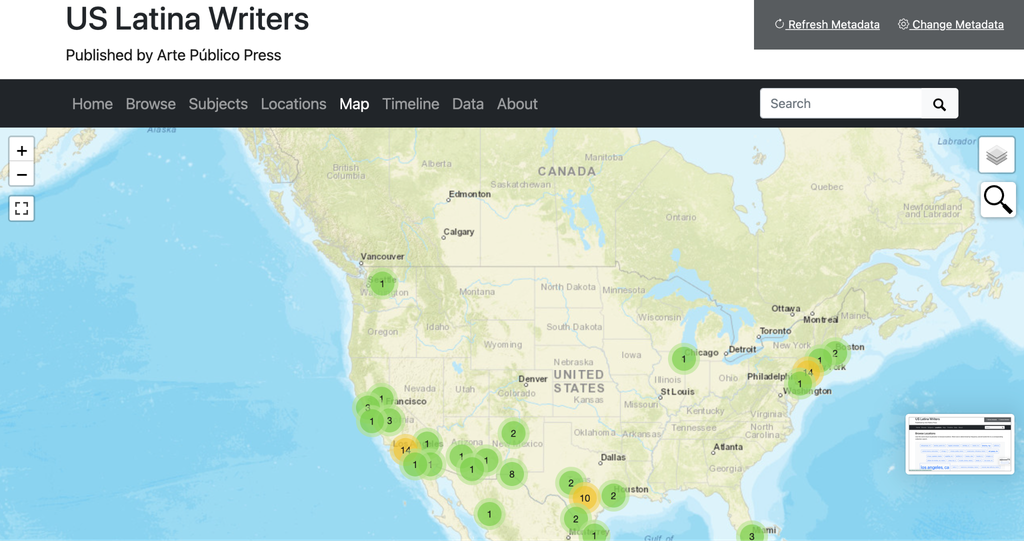
Interactive map found in the ‘Map’ tab on US Latina Writers (shown above).
The ‘Timeline’ tab provides a comprehensive list of all one hundred sixty-one literary works, oldest to most recent, in order from 1980 to 2024. Similarly, the ‘Data’ tab is an organized list of the works in the form of a table. The works are sorted by the date they were published, like in the ‘Timeline’ tab: oldest at the top to most recent at the bottom, with the title, description, and subjects in.
The ‘About’ tab at the end of the row of tabs tells how the website was created, why it was created, who created it, and reiterates the message at the bottom of the homepage summarizing what US Latina Writers is. This tab is important and helpful for credibility, and to understand the project. It lists the names of the developers, the publishing company, why this site was created, and how it can be helpful.
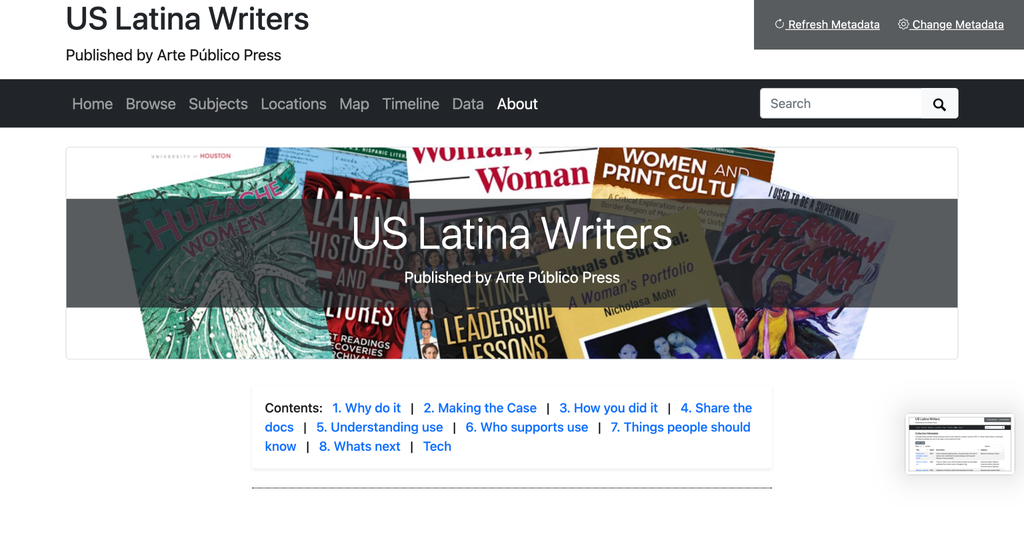
A portion of the ‘About’ tab screen (shown above).
The site’s design is aesthetically pleasing without being distracting or complicated. The simple use of colors in places like the logo and the map aim to help users, and to make the site look more interesting. There are some paragraphs of text, like in the ‘About’ tab, but nothing significantly long without breaks between the paragraphs. This amount of block text isn’t overwhelming, and is understandable for a site focused on reading and research.
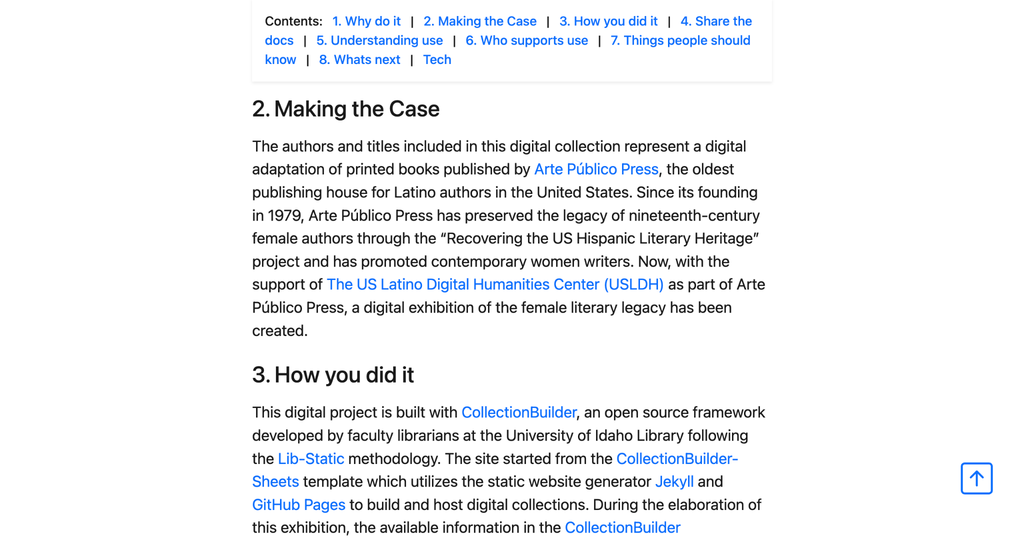
Paragraphs in the ‘About’ tab (shown above).
There are, however, some issues that I ran into. If you look up “US Latina Writers” on the internet, this site is not at the top of the results or even on the first page of results, and the URL is not very simple or self explanatory. This is not ideal for the site’s popularity or visibility. Although I could view the images, listen to the audio, and watch the videos, the download button did not work for me – that is, they didn’t download to my computer. I also could not find any written texts, which the description led me to believe were included. However, the images clearly show the title, author, and anything you need to know to find the book elsewhere. There are also descriptions of the works, mainly in the ‘Data’ tab. The audio files and video files work, and are readily available to listen to and watch.
US Latina Writers does not seem to have much bias. The only bias that it may have is favoring female Latina writers for the purpose of getting them more visibility and sharing these works that would otherwise be less popular than mainstream writers. It gives a different perspective, which discourages bias. The site doesn’t seem to feature any social media, which makes sense, since it’s a digital collection of Latina works.
Overall, this website seems accessible. I checked over much of the font and images using WebAIM, and a majority of it passes the color contrast test, at least to the AA level. Some, however, like the gray color of the tabs before you click on them, do not pass the test. As an essential part of the website, this can pose a significant problem for any visually impaired users. The audio files also do not have text to go along with them, which is an issue for deaf and hard of hearing users. However, the videos have captions, and you can set your own preferred contrast and size on the text of the captions, which is useful for both deaf and hard of hearing people and visually impaired people who can see large, high contrast fonts. These caption settings are widely used across YouTube, which is where most of the videos are based.

The tabs on US Latina Writers that do not pass WebAIM’s color accessibility test (above).
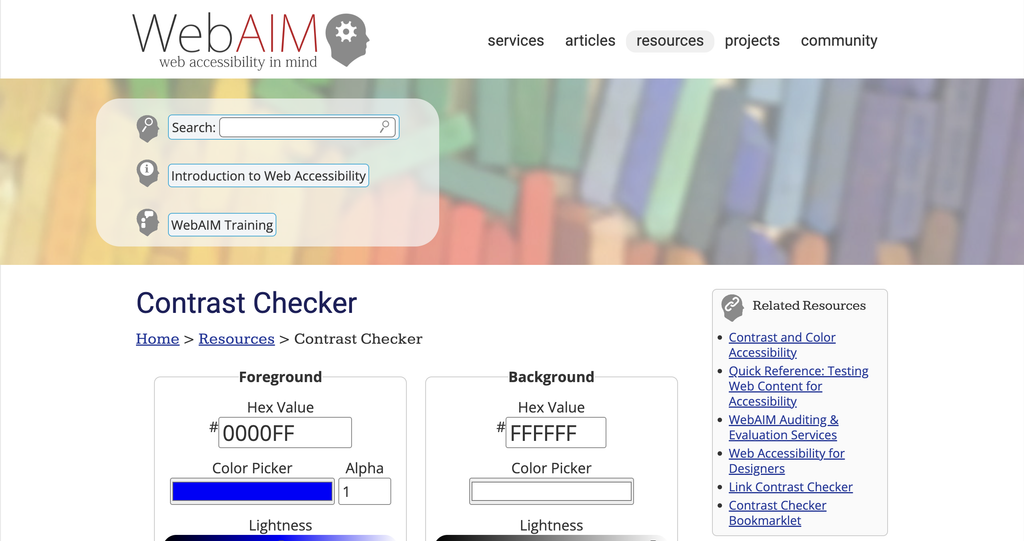
WebAIM’s color contrast checker (shown above).
US Latina Writers seems to be an effective use of its medium and design as a digital collection of audio, video, and image files. While there are some issues, like downloading some of the data, all of the included data is still available to users, and the navigation of this site is rather straight forward. The aesthetics are simple yet visually pleasing and not too confusing or distracting from the actual purpose of the site. The accessibility is fair, with some issues, and the web-friendliness is good.
Bibliography
Dabrowska, Monika, et al. “Home.” US Latina Writers, Arte Público Press, dhcast.github.io/US-Latina/. Accessed 23 Sept. 2026
US Latina Writers website: https://dhcast.github.io/US-Latina/
WebAIM Color Contrast Checker: https://webaim.org/resources/contrastchecker/
Leave a Reply